_edited.jpg)

Is AI the Future of Art? Unpacking Christie’s Augmented Intelligence Auction and the Copyright Debate
- propertylawsociety
- Feb 17, 2025
- 5 min read
Charlotte Boyd
JD Candidate, Co-Founder & President
With over two centuries as a dominant force in the art market, Christie’s Auction House is internationally celebrated for its expertise in fine art, luxury goods and collectibles. Established in 1766, Christie’s has established a reputation as a global leader in the auction industry and art market.

From February 20th to March 5th, 2025, Christie’s will host its inaugural artificial intelligence (AI) art auction, Augmented Intelligence, the first-ever AI-dedicated sale at a major auction house. However, this groundbreaking event has been nothing short of controversial, sparking a fierce debate over the role of AI in the art world.
What is AI Art?
AI art refers to any form of art created or enhanced using AI tools, demonstrating collaboration between human artists and technology.
AI-powered tools like DALL-E, Midjourney, and Stable Diffusion enable creators to work with algorithms or develop their own neural networks, producing art that is both innovative and disruptive to the traditional art world and market.
Christie’s Director of Digital Art, Nicole Sales Giles, emphasizes that “AI is not a substitute for human creativity. It enhances the human spectrum of creativity. It's about employing technology to push what is possible, exploring what is achievable outside of, but not separate from, human agency.”
While AI-generated art differs from traditional mediums like painting or sculpting, human input remains essential. Artists and engineers design and refine AI models, using coding as a creative craft and generating art through intricate algorithms and text prompts.
The History of AI Art in Action Houses
AI-generated art first made an impact on the artwork in October 2018 when Christie’s made history by auctioning Edmond de Belamy, a portrait created by the Paris-based art collective Obvious using AI. The work, generated through a machine-learning model known as Generative Adversarial Network (GAN), sold for $432,500, over $400,000 more than its initial estimate of $7,000 to $10,000. This landmark sale marked AI’s entry into the art market, sparking conversations about authorship and the evolving role of technology in artistic expression.

In November 2024, Sotheby’s further cemented AI’s place in the art world with the sale of A.I. God. Portrait of Alan Turing, a work created by the humanoid robot artist Ai-Da. The piece, which was generated using Ai-Da’s AI algorithms, sold for an astonishing $1,084,800 during the auction house’s Digital Art sale.
Ai-Da, named after 19th-century mathematician Ada Lovelace, is equipped with cameras, robotic arms, and advanced AI programming that allows her to draw and paint autonomously. The sale of this work not only showcased the evolving capabilities of AI in artistic creation but also fueled ongoing debates about authorship and the role of human agency in AI-generated works.

With Sotheby’s and Christie’s embracing AI art, these sales signal a shift in the art market - one where collectors and institutions are increasingly recognizing AI as a legitimate medium despite the ethical and legal controversies surrounding it.

The Backlash: AI Art and the Exploitation Debate
Artists worldwide are calling on Christie’s to cancel its Augmented Intelligence auction, which has been hailed by some as a groundbreaking moment for AI-generated art but condemned by others as a threat to copyright protection and artistic integrity.
On February 8th, 2025, an open letter demanding that Christie’s cancel the auction was published, stating that “many of the artworks you plan to auction were created using AI models that are known to be trained on copyrighted work without a license” and goes on to accuse the auction house of “rewarding and further incentivizing AI companies’ mass theft of human artists’ work.” As of February 17th, 2025, over 6000 artists and individuals in the art world have signed in support.
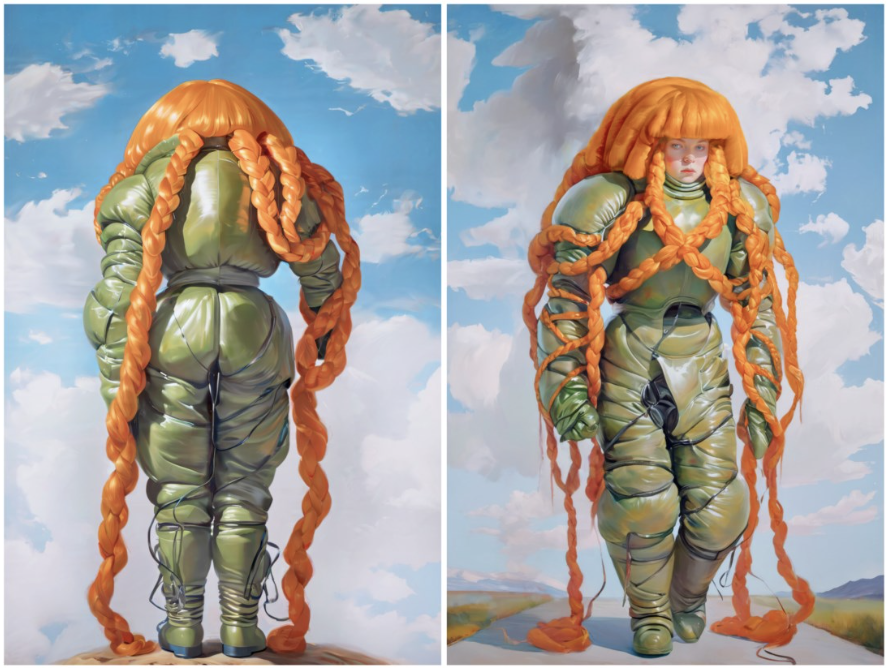
Among the signatories is a fine artist and illustrator, Kayla Ortiz, a leading AI awareness activist who has taken part in multiple class action lawsuits against the companies behind AI art-training services. These services, which scrape vast amounts of digital art, including copyrighted works, to train AI models, have become a significant point of contention between artists and technology companies. Many creatives argue that such practices amount to exploitation, leading to a wave of copyright lawsuits aimed at preventing the exploitation of creators and copyright owners through the unauthorized use of their work.
These legal battles reflect a larger fight for artists’ rights in the age of AI, as creatives seek to establish national and international policies to protect against the unauthorized use of copyrighted works.
Christie’s Response and Artists’ Enthusiasm
Christie’s has defended its Augmented Intelligence auction, emphasizing that the featured AI artists are using the technology to enhance, not replace, their creative practices. However, the controversy surrounding AI art raises broader legal and ethical questions, particularly regarding copyright.
Artists are furthering the discussion regarding AI-generated art, platforms and algorithms used to create these works.
Alexander Reben, an artist involved in the AI-generated art conversation, notes:
“AI models which are trained on public data are done so under the idea of ‘fair use,’ just as search engines once faced scrutiny for organizing book data (which was ultimately found to fall under fair use)... Responsibility for the use of these tools also falls upon the user. For instance, you could tell an AI to draw Mickey Mouse, and it might produce something that resembles a famous character. But this is different from someone walking into the MoMA, photographing a painting, and printing it on a t-shirt to sell. In both cases, the core issue is copying someone else’s creation without adding anything new. AI expands creative potential, offering new ways to explore, remix and evolve artistic expression rather than replace it. The future of art isn’t about AI versus artists - it's about how artists wield AI to push boundaries in the way we’ve never imagined before.”

Echoing this sentiment, Mat Dryhust, another prominent artist, argues…
“It is not illegal to use any model to create artwork. I resent that an important debate that should be focused on companies and state policy is focused on artists grappling with the technology of our time.”
Dryhurst points to a critical issue—the responsibility of tech companies to ensure that AI models respect copyright laws and ethical boundaries. He suggests that the focus of this debate should shift to legal frameworks and policies that govern AI training processes rather than placing the burden on individual artists who are exploring new creative tools.
As AI-generated art continues to grow, the only way to address the exploitative concerns raised by creators is for governments to implement regulations that hold technology companies accountable for their algorithmic training processes.
Despite the ongoing ethical concerns surrounding AI-generated art, the market demand for such work continues to grow. AI-generated works are gaining increasing recognition as legitimate forms of artistic expression. This shift suggests that, for many, AI is not just a passing trend but a new medium reshaping the landscape of art collecting.
As of February 17th, three days from the start of the auction, there is no sign of Christie’s backing down from making art history with the Augmented Intelligence auction.


Comments